
writing a Pratt Parser in C :part 1
/ 7 min read
Table of Contents
confessions of a young-MONK
To save my remaining braincells and personality, from a certain ennui which arises when AI is coming to take over your job, and especially when its taking too long…I decided to make a compiler from scratch. Dreamt of making one as a first-year..finally doing something i am really proud of.
the fact that i had made a Recursive-descent parser for my custom shell(komi.sh), I thought making one with a weird name(Pratt) would hardly require any effort! I was wrong! its something which felt odd, but beautiful.
recursive and pratt-parsing
Recursive descent works when the lookahead token tells you which rule to apply, if you know you’re parsing an if-statement, see while and you know it’s a loop. The leading keyword picks the branch, so the code is trivial.
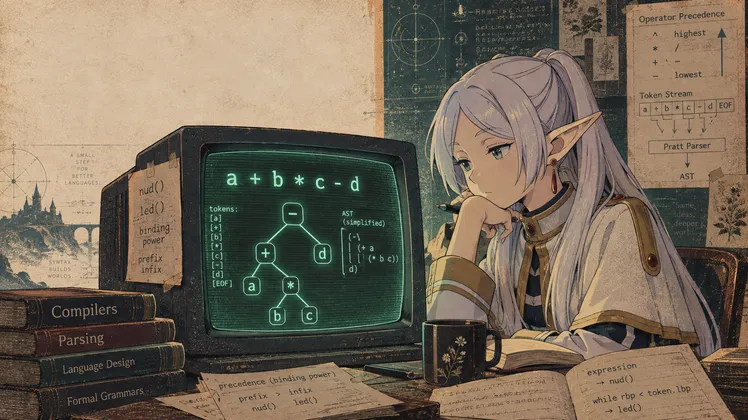
Expressions are where the trick fails. Look at a + b * c. The first token, a, tells you nothing about what follows. The operator comes after the left operand, so you can’t pick a rule from the first token. Prefix versus infix is also ambiguous: - means different things depending on position.
all of this can be done using Recursive-descent parsing but it would be very repetitive/lengthy as for any new precedence you would have to make a whole new function, but in pratt-parsing its just defining the precedence in the precedence table and knowing the ast shape to wire it upto, adding the switch-case and the rest is handled.
the thing is, pratt-parsing remained obscure for many years, when Mr.Pratt wrote the paper for dynamic languages originally in lisp, the lisp community didn’t care because the language itself doesn’t carry heavy syntax - Code is written as (+ 1 (* 2 3)), which is already a tree, therefore the demonstration of parser became useless/something not needed. The hand-written recursive descent was already good enough, parser-generator theory dominated textbooks, and the 1973 Vaughan Pratt’s paper is hard to read.
crux-
parsing is simply breaking the expression/tokens to form a tree;
- manually
- using a context free grammar - bnf(Backus Naur form)
You might remember the precedence and associativity concepts we learned in 5th grade, which determine the order in which operators are evaluated in an expression (like BODMAS).
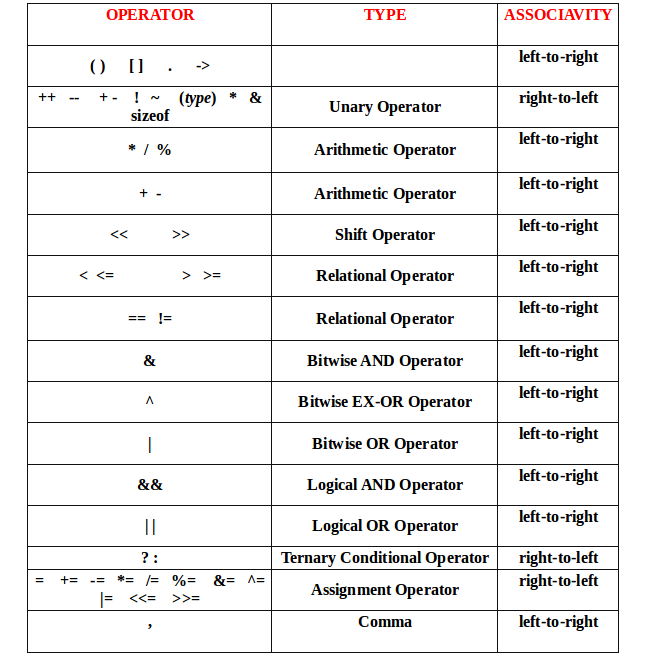
here’s an example -
notice that we assign the right side a value greater than the left so that when 2 operators of same precedence are in view, left-associativity is maintained.
expr:   A       +       B       *       C      +       2      /     4power:        3   3.1        5   5.1         3  3.1         5   5.1

expr:   A +       B  *  C      +       2  /  4power:  3   3.1              3   3.1

expr:   A +       MUL      +       DIV                  / \              / \                 B   C            2   4
power:  3  3.1            3   3.1

expr:   A + MUL      +  DIV            / \         / \           B   C       2   4power:              3  3.1

expr:    PlUS         / \        A  MUL        +  DIV            / \          / \           B   C        2   4

expr:         PlUS             /    \         PlUS     DIV         / \       / \        A  MUL    2   4            / \           B   C
nud and led
we utilize the above concept when making a pratt-parser and it handles the infix( tokens that are between an expression) and postfix( tokens that can BEGIN an expression) notations elegantly; for larping -
- prefix handler can be referred as nud (null denotation) handler —it processes tokens that can start an expression without needing a left-hand side context.
- infix handler can be referred as led (left denotation) handler —it processes tokens that expect to be between or after some other expression to its left.
building-it-in-c
I already had a finely-built lexer from the shell I made, slapped that in here, for you, yourself, manage a toy lexer or assume the tokens are something…we are born with. the parser has a general structure i copied while reading Nora Sandler’s Writing a C compiler.
parser struct
typedef struct Parser {  const Tokens *tokens;  uint32_t current; // to track the curr token;
  bool has_error;  bool in_panic_mode;
  // error handling;  size_t length;  size_t capacity;  Error *data;} Parser;
parsing_engine
Below is the engine, radical, parse_precedence(parser, precedence) means: parse an expression, but stop the moment you meet an operator weaker than precedence, it grabs the first token and hands it to parse_prefix, because whatever starts an expression is a prefix thing (a number, a name, a -, a (), that gives us left. Then the loop asks one question over and over: does the next token bind at least as tightly as the level I was called with? if yes, swallow the operator, hand left and the operator to parse_infix, and whatever comes back becomes the new left. if no, we’re done and the caller gets left. The associativity part is handled individually for each type.
ASTNode *parse_precedence(Parser *parser, Precedence precedence) {  Token token = parser_advance(parser);  ASTNode *left = parse_prefix(parser, token);  if (left == NULL)    return NULL;  while (precedence <=         get_precedence(get_token(parser->tokens, parser->current).tag)) {    Token op = parser_advance(parser);    left = parse_infix(parser, left, op);
    if (left == NULL)      return NULL;  }  return left;}
infix and postfix expressions
the prefix and infix handlers looked something like -
static ASTNode *parse_prefix(Parser *parser, Token token) {  // Tokens that can BEGIN an expression:  switch (token.tag) {
  case TOKEN_INTEGER:  case TOKEN_FLOAT:  case TOKEN_STRING:  case TOKEN_KEYWORD_TRUE:  case TOKEN_KEYWORD_FALSE:    return create_ast_literal(token);
  case TOKEN_IDENTIFIER:    return create_ast_identifier(token);
  case TOKEN_MINUS:  case TOKEN_NOT:    return parse_unary(parser, token);
  case TOKEN_LEFT_PAREN:    return parse_grouping(parser);
  default:    snprintf(msg, sizeof(msg), "komic: expected expression, got %s\n", token_tag_name(token.tag));    return NULL;  }}
ASTNode *parse_infix(Parser *parser, ASTNode *left, Token op)// Tokens that can be in-between expressions:{ char msg[128] = ""; switch (op.tag) {
// arithmetic case TOKEN_PLUS: case TOKEN_MINUS: case TOKEN_STAR: case TOKEN_SLASH: case TOKEN_PERCENT:
// equality case TOKEN_EQUAL_EQUAL: case TOKEN_NOT_EQUAL:
// comparison case TOKEN_LESS: case TOKEN_LESS_EQUAL: case TOKEN_GREATER: case TOKEN_GREATER_EQUAL:
// logical case TOKEN_AND_AND: case TOKEN_OR_OR: return parse_binary(parser, left, op);
// assignment case TOKEN_EQUAL: return parse_assignment(parser, left, op);
// function call case TOKEN_LEFT_PAREN: return parse_call(parser, left);
default: snprintf(msg, sizeof(msg), "komiLang: invalid infix operator %s", token_tag_name(op.tag)); parser_error(parser, msg);
return NULL; }}left/right associativity
as discussed above, Precedence tells you * beats +, but what happens when the same operator shows up twice, like 8 - 3 - 2? group it from the left, (8 - 3) - 2, and you get 3. group it from the right, 8 - (3 - 2), and you get 7. same tokens, different answer, so the parser has to pick a side. Most operators are left-associative: -, /, + but assignment is the rebel: a = b = c has to mean a = (b = c), otherwise you’re assigning c to the result of a = b, which is idiocy.
In my parser the whole difference is one + 1. parse_binary calls back into parse_precedence with precedence + 1, so when the inner call peeks at the next -, its own level is now too high to accept it. it stops, hands back 3, and the outer loop picks up the second - with (8 - 3) as its left side, which leans the tree left. parse_assignment recurses with the same precedence, so the inner call is allowed to swallow the next = and the tree leans right. one number decides which way the tree falls.
static ASTNode *parse_assignment(Parser *parser, ASTNode *left, Token op) {  // NOTE: Assignment is RIGHT associative.  Precedence p = get_precedence(op.tag);
  ASTNode *right = parse_precedence(parser, p);
  if (right == NULL)    return NULL;
  return create_ast_binary(op, left, right);}
static ASTNode *parse_binary(Parser *parser, ASTNode *left, Token op) {  Precedence a = get_precedence(op.tag);  // NOTE: +1 makes ordinary binary operators LEFT associative.  ASTNode *right = parse_precedence(parser, (Precedence)(a + 1));
  if (right == NULL)    return NULL;
  return create_ast_binary(op, left, right);}
that’s it?
this concludes the part1 of the compiler creation journey;
The parser now handles expressions: literals, unary minus and not, binary operators, grouping, assignment, and function calls, all from one while loop and a precedence table..
upcoming is where it actually becomes a true parser: [block and declarations parsing, panic mode, function calls, etc ].
sayonara…